
Why Automated Warehouses Need a Warehouse Control System (WCS)
Oct 08, 2026
WCS: The Missing Orchestration Layer for Automated Warehouses
Warehouse automation is accelerating. From AutoStore and ASRS solutions to conveyor systems, robotics, and AMRs, organizations are investing heavily in technologies that improve throughput, storage density, and operational efficiency.
Yet as automation expands, a new challenge emerges: how do all these systems communicate, coordinate, and execute warehouse processes as one connected operation?
Many organizations discover that integrating warehouse automation is often more complex than the automation itself. Every vendor brings its own interfaces, communication methods, and integration requirements, creating an increasingly fragmented technology landscape.
This is where a Warehouse Control System (WCS) becomes essential.
The Growing Complexity of Warehouse Automation
Modern warehouses rarely rely on a single automation technology. Instead, they combine multiple solutions that must work together seamlessly:
- AutoStore and high-density storage systems
- Automated Storage & Retrieval Systems (ASRS)
- Mini-load systems
- Conveyor and sortation networks
- Robotics and autonomous mobile robots (AMRs)
- Scanning and sensor technologies
While each solution is designed to optimize a specific area of warehouse operations, connecting them to Microsoft Dynamics 365 Warehouse Management can quickly become a challenge.
Without a standardized control layer, organizations often face:
Custom Integration Complexity
Each automation system requires a separate integration with the WMS, increasing implementation effort, costs, and ongoing maintenance requirements.
Lack of Standardization
Different automation technologies communicate using different protocols and interfaces, making warehouse operations difficult to manage and scale.
Vendor Lock-In
Organizations can become dependent on specific automation vendors, limiting flexibility when introducing new technologies.
Growing Pressure on the WMS
As warehouse environments become more automated, the complexity of coordinating workflows can exceed what traditional WMS integrations were designed to handle.
Why Automated Warehouses Need an Orchestration Layer
A Warehouse Control System acts as the intelligent layer between Dynamics 365 Warehouse Management and automation technologies.
Rather than building direct integrations between the WMS and every automation system, WCS provides a single standardized framework that manages communication, workflow execution, and operational coordination.
This orchestration layer helps organizations:
Connect Disparate Systems
WCS creates a reliable communication path between Dynamics 365 Warehouse Management and multiple automation technologies, regardless of vendor.
Coordinate End-to-End Execution
Warehouse activities are translated into synchronized tasks, confirmations, and inventory movements across automated zones.
Scale Without Disruption
New automation technologies can be added without redesigning or rebuilding existing integrations with the WMS.
How WCS Works
At its core, WCS serves as the operational control tower for warehouse automation.
Dynamics 365 Warehouse Management sends warehouse instructions into WCS. WCS then orchestrates and coordinates activities across automation systems while managing confirmations, status updates, and workflow execution.
Instead of every automation solution connecting directly to Dynamics 365, each system communicates through a standardized integration layer maintained by WCS.
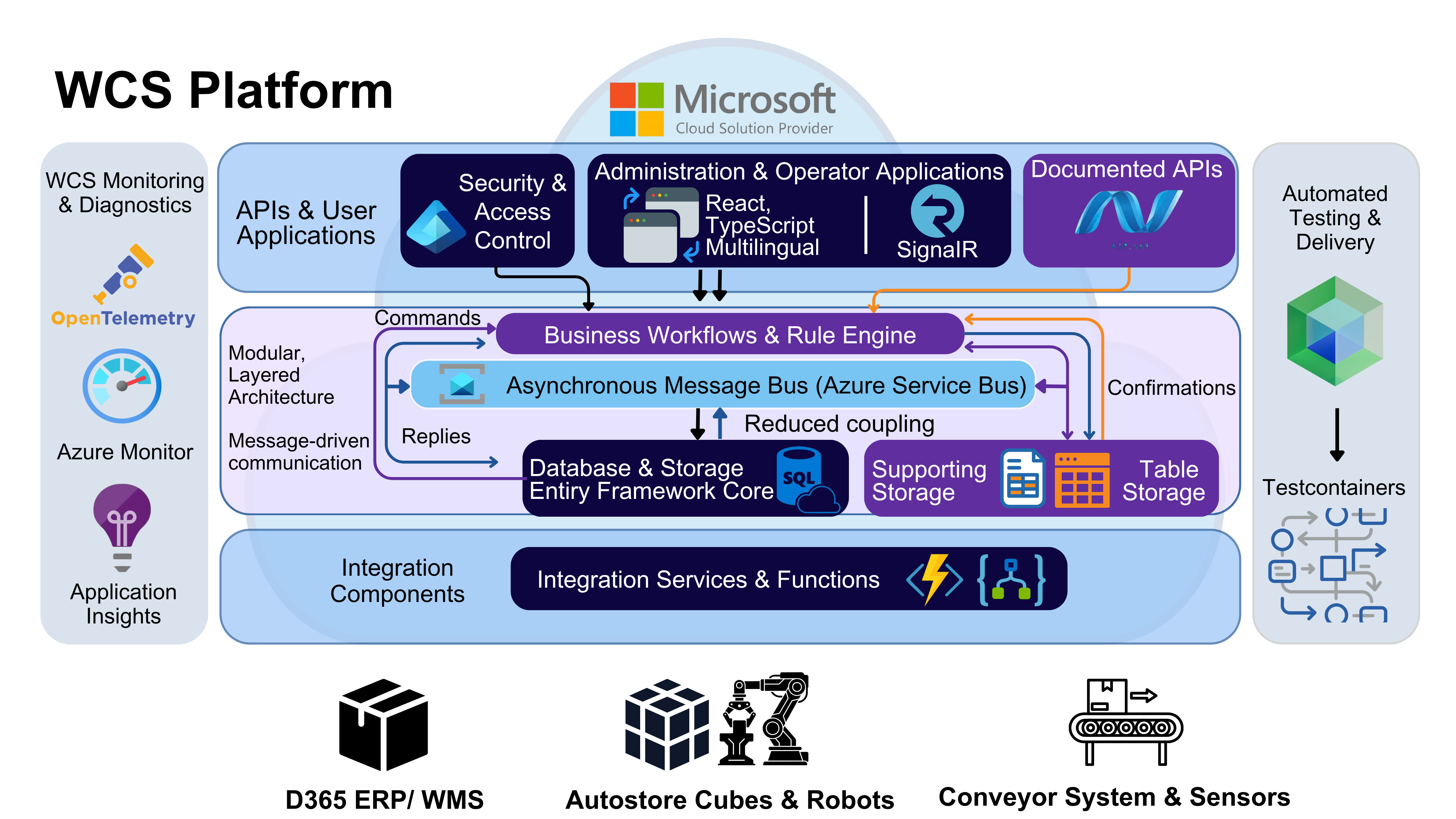
Suggested placement: Insert the "WCS Platform Architecture" visual immediately below this section.
Suggested caption:
WCS acts as the orchestration layer between Dynamics 365 Warehouse Management and warehouse automation technologies, coordinating workflows through standardized integrations and real-time communication.
The visual helps demonstrate:
- Dynamics 365 WMS as the source of operational instructions
- WCS business workflows and rule engine
- Azure-native messaging architecture
- Standardized integration services
- Communication with automation technologies such as AutoStore, robotics, conveyors, and ASRS systems
- Monitoring, security, testing, and operational control
Built Natively on the Microsoft Cloud
Unlike traditional middleware solutions, WCS is built specifically for Microsoft Dynamics 365 Warehouse Management and the Microsoft ecosystem.
The platform leverages Azure-native technologies to provide:
- Scalability for growing automation environments
- Enterprise-grade security and access control
- High availability and operational resilience
- Native integration with Microsoft services and standards
This allows organizations to benefit from a solution that feels like a natural extension of their Dynamics 365 environment rather than an external layer that must be separately maintained.
Key Capabilities of WCS
Vendor-Agnostic Integration
WCS provides a standardized integration framework, eliminating the need for custom point-to-point integrations and simplifying automation projects.
Intelligent Workflow Orchestration
Business rules, warehouse workflows, confirmations, and execution logic are coordinated centrally, ensuring smooth end-to-end operations.
Enterprise-Grade Security & Reliability
Built on the Microsoft Cloud, WCS delivers secure, resilient, and highly available warehouse operations.
Real-Time Visibility & Operational Control
Warehouse and IT teams gain operational insight through monitoring, diagnostics, and real-time visibility into automation workflows.
Modular & Extensible Architecture
Organizations can expand warehouse automation capabilities over time without disrupting existing operations or integrations.
Where WCS Delivers Value
WCS is designed for a broad range of warehouse automation scenarios, including:
AutoStore & High-Density Storage
Maximize storage efficiency while maintaining seamless alignment with Dynamics 365 Warehouse Management.
Automated Storage & Retrieval Systems (ASRS)
Simplify the integration and coordination of highly automated storage environments.
Conveyor & High-Speed Sortation Systems
Ensure reliable and efficient material flow throughout warehouse operations.
Robotics & Autonomous Technologies
Coordinate robotic movements and automated tasks as part of an integrated warehouse process.
Multi-Vendor Automation Environments
Bring different automation providers together under one standardized control framework.
The Business Benefits
Organizations implementing WCS can realize several strategic advantages:
Reduced Integration & Maintenance Costs
A standardized integration framework minimizes custom development, support overhead, and long-term maintenance effort.
Faster Automation Adoption
Teams spend less time managing integration complexity and more time realizing operational improvements.
Greater Operational Flexibility
Organizations can select the best automation technologies for their environment without being constrained by a single vendor ecosystem.
Scalable Warehouse Growth
As automation requirements evolve, WCS provides a foundation that supports expansion without increasing integration complexity.
A Structured Implementation Journey
Successful warehouse orchestration requires more than technology. WCS follows a structured implementation approach:
-
Assess & Discover
Evaluate warehouse processes, automation landscape, and integration requirements. -
Design the Solution
Define architecture, workflows, automation interfaces, and operational requirements. -
Connect & Configure
Deploy WCS and establish standardized integrations with Dynamics 365 and automation systems. -
Test & Validate
Verify workflows, inventory movements, automation communication, and operational scenarios. -
Go Live & Scale
Launch operations with continuous monitoring and the flexibility to expand automation over time.
The Future of Warehouse Automation Requires Orchestration
Warehouse automation is no longer about connecting one system to another. It is about creating a scalable, coordinated ecosystem where technologies work together as a unified operation.
As organizations continue to introduce new automation technologies, the need for a standardized orchestration layer becomes increasingly important.
WCS bridges the gap between Microsoft Dynamics 365 Warehouse Management and warehouse automation technologies, providing the connectivity, coordination, visibility, and scalability required for modern warehouse operations.
By replacing custom integrations with a standardized, vendor-agnostic framework, organizations can reduce complexity, accelerate automation initiatives, and build a warehouse platform ready for future growth.
Ready to streamline your warehouse automation landscape?
Explore how WCS can help you connect, orchestrate, and scale warehouse automation within Microsoft Dynamics 365 Warehouse Management.
